
Mikavi Care Guide
The Three Mushrooms
Nourish Broth is powered by Lion's Mane, Cordyceps and Tiger Milk, one of them growing right here in Malaysian soil. Here is what each one does, told straight, including what the science does and does not say yet.
First, the obvious worry
If your first thought on reading "mushrooms" and "dog" in one sentence is the emergency vet, that instinct is correct and you should keep it. Wild mushrooms are genuinely dangerous. There is no reliable way to identify a safe one by looking at it, and some species can do serious liver damage within days.
That is exactly why formulated mushrooms exist. The three in Nourish Broth are named, sourced and cooked into the broth. They are not foraged and they are not a garden variety.
So keep pulling your dog away from whatever is growing at the park. This is the opposite of that.
Start here: what's your dog's vibe lately?
Tap the one that sounds most like your house.
Lion's Mane, the Mind
For the sharp, focused, present dog, at every age
"The mushroom that helps the brain feed itself."
Lion's Mane compounds nudge nerve cells to make more NGF, one of the brain's own growth signals. That is the throughline behind its reputation for supporting a present, engaged mind. It is also traditionally used for gut comfort, and the gut and brain talk to each other more than anyone expected.
Cordyceps, the Energy
For the get-up-and-go, from the inside out
"Get-up-and-go from the inside out."
Cordyceps activates AMPK, the body's own energy switch, helping turn food and breath into real, usable energy. In traditional Chinese practice it has been the lung-and-vitality tonic for centuries. It is the one for the professional nappers, not for turbocharging already-athletic dogs, and we would not pitch it that way.
Tiger Milk, the Resilience
Malaysia's own apothecary treasure
"Malaysia's own apothecary treasure."
Tiger Milk mushroom, cendawan susu rimau, grows here and almost nowhere else. Malaysian folk medicine has used it for generations to ease coughs and steady the body. Modern research points the same direction: its beta-glucans help balance the immune response rather than crank it up, which is why we call it the resilience pillar, the shrug-off-whatever-the-day-brings mushroom.
Why the honesty box?
Because you have seen pet products that promise everything. We decided early that Mikavi would only ever say what the evidence supports: "supports", "helps", "traditionally used", and never "cures". If a claim ever sounds too good on our packaging, hold us to this page.
One more honest line: none of this replaces your vet. If your dog is on medication, have a five minute chat with your vet before starting. Worth flagging specifically: anti-inflammatories for stiff joints, blood thinners and blood pressure medication, since lion's mane may add to their effect on bleeding. Same for a dog with a bleeding disorder, diabetes or a compromised immune system. That is the together-longer way.
Why not just make broth at home, or buy the carton at the supermarket?
Fair question. For plain broth, the honest answer is that you can.
Here is why we would not reach for the supermarket carton. Onion and garlic are in most human stock, and both are toxic to dogs. "Low sodium" on the front does not mean allium free, so the ingredients list is the part that matters. Human broth is also seasoned for human tongues.
And the part no carton can do: it has no mushrooms in it. The broth is how the mushrooms get into the bowl. The broth is the delivery, not the point.
If you make your own, unsalted and free of onion and garlic, that is a genuinely good thing to give your dog. It is simply not the same product.
Know another devoted dog parent?
Send them Malaysia's own mushroom. They will thank you twice.
Share on WhatsAppWant the good stuff in your inbox?
Care tips and straight talk from our kitchen, no spam, unsubscribe anytime.
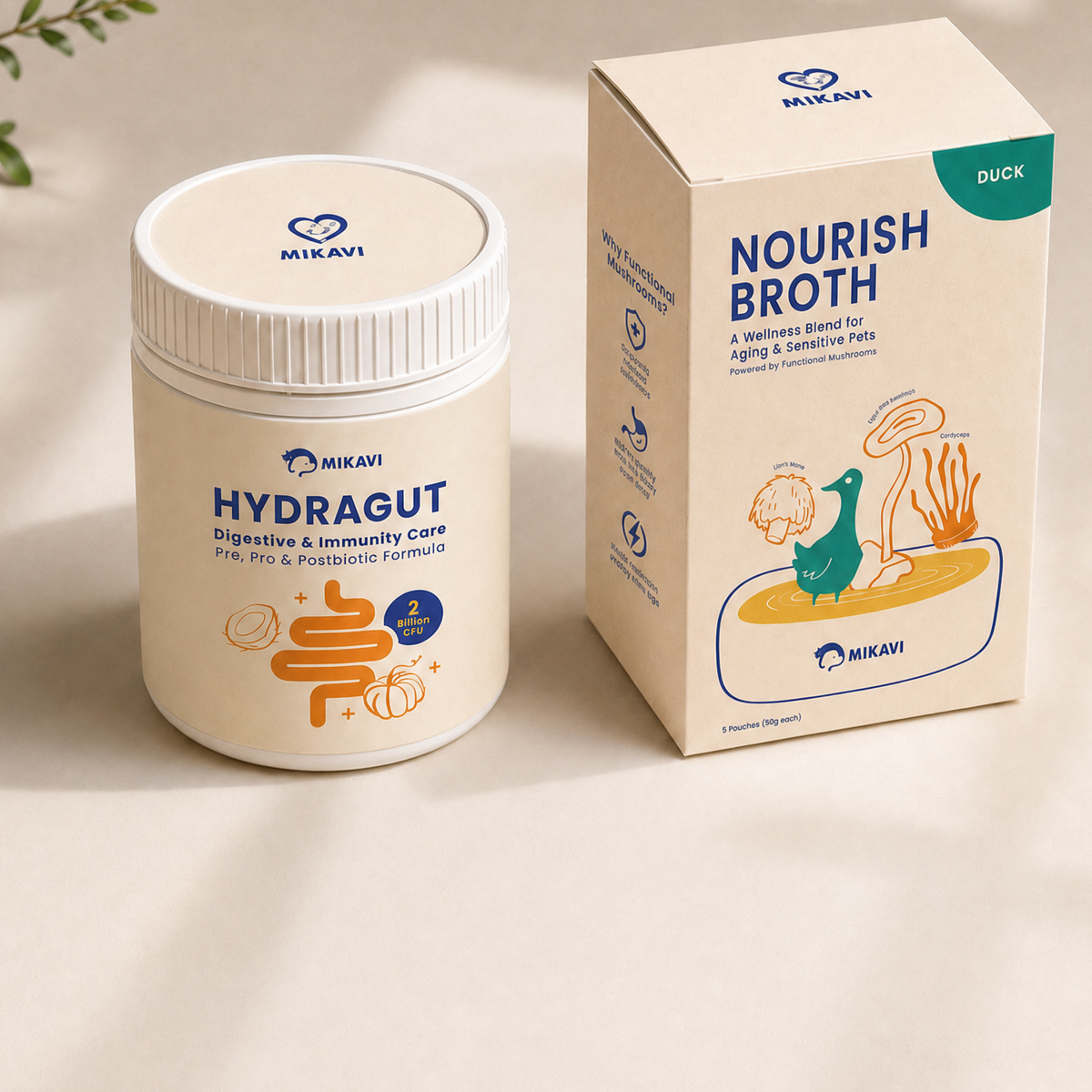
All three, in one bowl
Nourish Broth brings the Mind, the Energy and the Resilience together in a pour-over broth your dog queues up for. Chicken, duck or fish.
See Nourish BrothNext read: The first 14 days: what to expect when you start the routine →